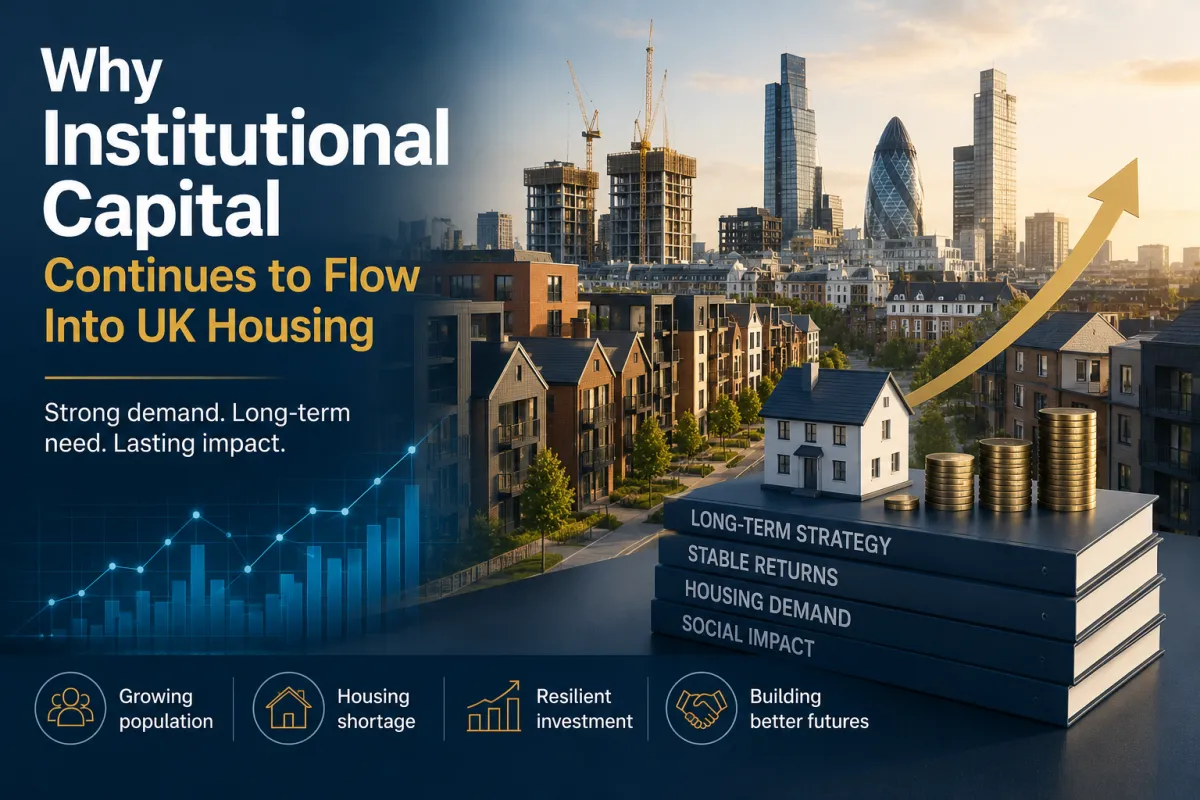
Why Institutional Capital Continues to Flow Into UK Housing
The UK housing market continues to attract significant attention from institutional investors, including banks, pension funds, insurance companies, and large investment firms.
Despite economic uncertainty, interest rate fluctuations, and ongoing housing policy discussions, institutional capital continues to be allocated toward housing-related sectors across the UK.
But why?
The answer lies in a combination of long-term housing demand, supply constraints, demographic trends, and the essential role housing plays within the wider economy.
Housing Remains a Fundamental Need
Unlike many asset classes, housing is tied to a basic societal need.
The UK continues to face challenges around:
housing affordability
housing supply
population growth
changing household formation
Government and industry reports continue to highlight the need for additional housing across various tenures and housing types.
This long-term demand profile is one reason housing remains an area of interest for institutional investors.
Housing Supply Continues to Lag Demand
The UK has faced housing supply challenges for many years.
According to industry bodies and housing organisations, new housing delivery has often fallen short of estimated requirements.
This imbalance between supply and demand is frequently cited as a factor supporting continued investment into the housing sector.
However, housing demand and market conditions can vary significantly by region and property type.
Growth of the UK Living Sector
Institutional investment is no longer focused solely on traditional residential property.
The broader "living sector" now includes:
Build-to-Rent (BTR)
student accommodation
later living
affordable housing
supported housing
These sectors have attracted attention because they address specific housing needs within the UK population.
According to CBRE, the UK living sector continues to be viewed as an important part of the country's real estate landscape.
Long-Term Investment Horizons
Many institutional investors operate with long-term investment horizons.
Examples include:
pension funds
insurance companies
sovereign wealth funds
These organisations often seek assets linked to long-term demographic and economic trends.
Housing is frequently considered within this context because demand is influenced by population growth, urbanisation, and housing requirements.
Regeneration and Infrastructure Investment
Institutional capital is also being directed toward:
urban regeneration projects
large-scale residential developments
mixed-use communities
Cities such as Birmingham, Manchester, Leeds, and other regional hubs continue to attract investment due to infrastructure improvements and long-term development plans.
These projects often form part of broader economic growth strategies.
Housing as Part of National Infrastructure
Increasingly, housing is being discussed not only as a property asset but also as part of the UK's wider social and economic infrastructure.
Investment into housing can support:
community development
regeneration
housing delivery
urban growth
This broader perspective has contributed to continued institutional interest across multiple housing sectors.
Important Considerations
While institutional capital continues to flow into housing, investment decisions remain subject to:
market conditions
regulation
financing costs
policy changes
regional demand dynamics
Institutional investment activity does not guarantee future performance and should not be interpreted as an indicator of investment outcomes.
Conclusion
The continued flow of institutional capital into UK housing reflects a combination of long-term housing demand, supply challenges, demographic trends, and the growing importance of the wider living sector.
As the housing market evolves, institutional investors appear to be maintaining interest in sectors that support housing delivery and address changing housing needs across the UK.
Understanding these trends can provide useful insight into the broader direction of the UK's housing market.
FAQs
What is institutional capital?
Institutional capital refers to money invested by organisations such as pension funds, insurance companies, banks, and investment firms.
Why are institutions interested in UK housing?
Housing is linked to long-term demographic and housing demand trends, making it a sector many institutions monitor closely.
Does institutional investment only focus on traditional housing?
No. Many institutions invest across the wider living sector, including Build-to-Rent, student accommodation, affordable housing, and supported housing.
Does institutional investment guarantee market growth?
No. Institutional investment activity does not guarantee future market performance and should not be viewed as investment advice.
Interested in staying informed about UK housing trends, market developments, and the factors shaping today's property sector?
Join our network for educational insights, housing market updates, and discussions on the trends influencing the UK's evolving property landscape.
References & Sources
https://www.cbre.com/insights/books/uk-real-estate-market-outlook-2026/living
https://www.jll.co.uk/en/trends-and-insights/research/living-capital-markets-report
⚠️ Disclaimer: This article is for general information only and should not be relied upon as legal, financial, or investment advice. Property investments carry risks, and regulatory requirements remain subject to interpretation and change. Please seek professional advice tailored to your circumstances.
