Pre-October checklist: Three regulatory clocks that every supported living investor should be watching
As summer draws to a close, three regulatory deadlines in late September and early October 2026 are approaching for anyone active in UK supported living. These are not distant policy ideas. They are near-term clocks that will affect development costs, resident finances, and inspection frameworks. Understanding them now allows investors, developers and operators to prepare rather than react.
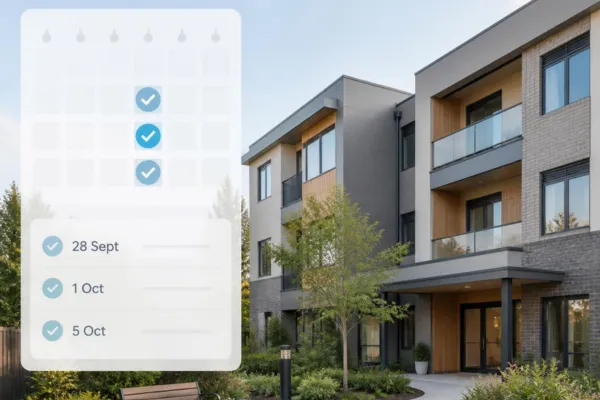
The three dates that matter most are the close of Ofsted’s consultation on children’s social care inspections (28 September), the start of the Building Safety Levy (1 October), and changes to Housing Benefit earned-income rules (5 October). Each carries distinct implications for the sector.
Ofsted consultation close: 28 September 2026
Ofsted is consulting on reforms to the frameworks it uses to inspect local authority children’s services (ILACS) and children’s social care providers under the Social Care Common Inspection Framework (SCCIF). The consultation, which opened in early July, closes at 11:59pm on 28 September 2026. Full details are available on the official consultation page: Improving the way Ofsted inspects children’s social care. Proposals include a move to a five-point grading scale with report cards, greater emphasis on children’s voices and enduring relationships, stronger alignment with wider government reforms, and closer scrutiny of how local authorities meet their sufficiency duties. Supported accommodation for looked-after children and care leavers aged 16 and 17 falls within the SCCIF, so providers in this part of the market will feel the eventual changes. A particular focus is the growth in unregistered provision and how local authorities commission placements.
Investors and operators with exposure to children’s supported accommodation should review the consultation documents, consider submitting a response if they have operational evidence, and begin mapping how current practice aligns with the emerging priorities around relationships, outcomes and sufficiency. Developers planning new schemes in this segment may want to factor in potential shifts in local authority commissioning preferences once the final frameworks are published.
Building Safety Levy: 1 October 2026
The Building Safety Levy comes into operation on 1 October 2026 under the Building Safety Levy (England) Regulations 2025. Official guidance is set out here: Building Safety Levy: Guidance. It is a charge payable on certain building control applications for major residential developments (generally 10 or more new dwellings, or 30 or more purpose-built student accommodation bedspaces) that create new residential floorspace. Rates are set per square metre of gross internal area and vary by local authority according to average house prices. A 50 per cent discount applies to qualifying previously developed land. Importantly for the supported living sector, properly structured supported housing provided by a local authority, housing association, charity or voluntary organisation (where care, support or supervision is also provided) is exempt, as are children’s homes, care homes and most forms of social and affordable housing. Applications submitted before 1 October 2026 are generally outside the scope of the levy, subject to the detailed transitional rules.
Developers and investors should audit pipelines immediately and, where commercially sensible, consider submitting building control applications before the deadline for schemes that would otherwise be chargeable. For supported living projects, the priority is confirming that the proposed structure, landlord and support arrangements meet the precise exemption definitions and that evidence can be provided at the relevant stages. Operators taking on newly developed stock will want clarity on whether any levy liability has been (or will be) incurred and how it has been treated in the project economics.
Housing Benefit earned-income changes: 5 October 2026
From 5 October 2026, new earned-income disregards apply to working-age Housing Benefit claimants living in specified accommodation (the category that covers most supported housing) or temporary accommodation. The changes are set out in The Housing Benefit (Earned Income Disregards) (Amendment) Regulations 2026. These introduce higher weekly amounts that can be ignored when calculating entitlement. The policy aim is to reduce the previous “cliff edge” that could leave some residents worse off when they increased their hours or took employment, and to bring the treatment of earnings closer to Universal Credit rules. Government estimates suggest the change will affect more than 300,000 people. The practical effect should be stronger incentives for residents to work without sudden large reductions in benefit, which in turn supports tenancy sustainment and positive outcomes.
Operators should prepare clear information for residents and support staff so that people understand how the new disregards work. Any internal practices that previously discouraged work in order to protect rental income will need review. Investors can reasonably factor improved work incentives into assumptions about residual income, void risk and longer-term demand for schemes that rely on Housing Benefit.
Risk and opportunity overview
Ofsted consultation (28 September): The main risk is that future inspection frameworks and local authority commissioning criteria become more demanding for children’s supported accommodation. The opportunity lies in clearer expectations and a potential preference for high-quality registered provision. Priority action is to review current practice against the proposed emphases and consider responding to the consultation.
Building Safety Levy (1 October): The main risk is additional cost on non-exempt residential schemes submitted after the deadline. The opportunity is that structured supported housing (and related social uses) remains exempt. Priority action is to audit the pipeline, evidence exemptions carefully, and consider pre-deadline applications where appropriate.
Housing Benefit changes (5 October): The main risk is limited if communications and support are poorly handled. The opportunity is stronger work incentives that support resident finances and tenancy stability. Priority action is to update resident and staff guidance and revisit any work-discouraging practices.
These three developments sit within a wider landscape of building safety reform, welfare policy and children’s social care improvement. None of them operates in isolation. The levy interacts with how schemes are structured and evidenced. The Housing Benefit changes affect the day-to-day finances of the people living in supported accommodation. The Ofsted consultation will shape the inspection and commissioning environment for one important part of the market.
For investors, the practical response is the same across all three clocks: map exposure early, gather the right evidence, and avoid last-minute decisions. Developers need particular clarity on levy scope and exemption evidence. Operators are closest to residents and to inspection outcomes, so communication and practice alignment matter most for them.
The next few weeks offer a short window to review pipelines, structures and operational readiness before the September and October deadlines arrive.
👉 Want to understand how these three regulatory deadlines could affect your supported living portfolio strategy? Connect with Shannon Hoang at SHPC to explore how we help investors and providers navigate these changes with clarity and confidence.
⚠️ Disclaimer: This article is for general information only and should not be relied upon as legal, financial, or investment advice. Property investments carry risks, and regulatory requirements remain subject to change. Please seek professional advice tailored to your circumstances.
