Specialist Lending and Capital Structures: What UK Property Investors Should Understand
In today’s UK property market, access to finance often determines whether a supported living scheme, social housing project, complex buy-to-let portfolio or development opportunity can proceed. Mainstream high-street banks have become more selective in their lending criteria. This has increased the role of specialist lenders and the importance of understanding how capital is structured in a deal. For investors focused on supported living and related sectors, these tools can open doors that standard products close, but they also introduce different costs, terms and risks that need careful evaluation.
What specialist lending involves
Specialist lending refers to finance provided by non-bank or challenger lenders that assess cases on a more individual basis rather than relying solely on automated credit scoring or standard high-street criteria. These lenders typically focus on situations involving complex income, non-standard property types, shorter-term needs, adverse credit elements, or assets that require specialist underwriting.
In the property context, common products include bridging finance for acquisitions or auctions, development finance for conversions or new builds, specialist buy-to-let and HMO facilities, and commercial or asset-based lending. Supported living and social housing investments often fall into this category because of factors such as care provider covenants, local authority or commissioner income streams, planning complexities, and the need for flexible drawdowns during refurbishment or fit-out phases.
Specialist lenders generally prioritise the underlying asset, cash-flow profile and exit strategy. This can make them more adaptable for investors whose proposals do not fit conventional residential or commercial boxes. At the same time, pricing is usually higher than mainstream bank rates, terms may be shorter, and documentation or covenant packages can differ.
Understanding capital structures
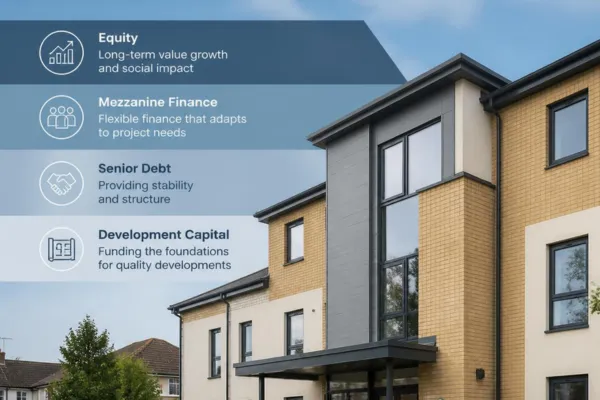
A capital structure (sometimes called the capital stack) describes the layers of funding used in a property transaction and the order in which those layers are repaid if things go wrong. At the top sits senior secured debt, which has first claim on the asset and cash flows and therefore carries the lowest risk and usually the lowest cost. Below that may sit mezzanine or subordinated debt, unitranche facilities that blend senior and junior elements into a single instrument, preferred equity, and finally common equity, which absorbs losses first and expects the highest potential return.
In a typical supported living or development deal, senior specialist debt might cover a significant portion of the purchase or works cost, with equity or additional junior capital filling the gap. The precise mix affects overall leverage, monthly debt service, covenant headroom and the investor’s residual risk. Understanding each layer’s priority, cost and flexibility helps investors assess whether the structure aligns with the income certainty of the underlying asset (for example, long-term care contracts versus shorter-term lettings).
Specialist lenders themselves also operate within capital structures. Many rely on warehouse facilities, asset-based lines, private credit partnerships or securitisation-style funding rather than traditional deposits. Recent industry surveys indicate that a large majority of specialist lenders are actively reviewing, renewing or expanding their own debt facilities to support loan-book growth, while some face constraints on equity availability. See the 2026 Interpath Specialist Lender Survey for current figures on debt facility activity and equity pressures across the sector.
Opportunities and risks for investors
The main opportunity lies in access and flexibility. Complex supported living schemes, conversions of existing stock, multi-unit portfolios or projects with non-standard planning can struggle to secure mainstream bank funding. Specialist lenders with experience in these areas may provide tailored solutions that match drawdown needs or accept certain income profiles that automated systems reject. Product diversification among specialists has also increased options in niche segments.
Risks need equal attention. Higher interest costs reduce net yields. Shorter loan terms create refinance risk at a future date when market conditions or lender appetite may differ. Covenants may be more tightly linked to asset performance or specific milestones. Dependence on a specialist lender’s own funding lines introduces an additional layer of market sensitivity. Regulatory capital rules that affect banks can indirectly shape the competitive landscape and the relative attractiveness of specialist alternatives. Property investors must also factor in broader changes such as higher tax rates on property income scheduled for later years and ongoing energy-efficiency requirements.
Energy Performance Certificate (EPC) and Minimum Energy Efficiency Standards (MEES) rules remain relevant. The current minimum for private rented properties is band E, with government intentions to raise the standard toward band C by 2030 for many tenancies, subject to cost caps and exemptions. See the government response on improving the energy performance of privately rented homes and related guidance for the latest position. Older stock that requires significant upgrades can affect both letting compliance and a lender’s willingness to refinance, making energy performance a practical consideration within any capital structure discussion.
Practical points for investors and providers
Investors considering specialist finance should start by mapping the full capital stack of any proposed deal and stress-testing cash flows under different interest-rate, occupancy and void scenarios. Questions worth exploring include the lender’s own funding sources and track record, the precise priority of each layer of capital, exit and refinance options, and how covenants interact with the income profile of a supported living or social housing asset.
Working with experienced commercial finance brokers who understand both the specialist market and the particular requirements of supported living can help identify suitable options. Independent legal, tax and financial advice remains essential before committing. Portfolio-level thinking is useful: a mix of senior and more flexible capital across different assets can improve overall resilience, but only if the cost and risk of each layer are clearly understood.
Specialist lending and carefully designed capital structures have become important parts of the funding landscape for UK property investors, particularly those operating in supported living, social housing and other complex segments. They expand the range of viable projects while introducing different pricing, term and covenant characteristics that require thorough evaluation. Staying informed about lender funding conditions, regulatory developments and energy-efficiency rules helps investors make measured decisions that align with long-term portfolio objectives.
👉 Want to understand how specialist lending options and capital structures could support your supported living, social housing or portfolio strategy in the current market? Connect with Shannon Hoang at SHPC to explore how we help investors and providers navigate these areas with clarity and confidence.
⚠️ Disclaimer: This article is for general information only and should not be relied upon as legal, financial, or investment advice. Property investments carry risks, including those related to lending terms, interest rates, refinance availability and regulatory change. Energy efficiency requirements and tax rules remain subject to further development. Please seek professional advice tailored to your circumstances.
