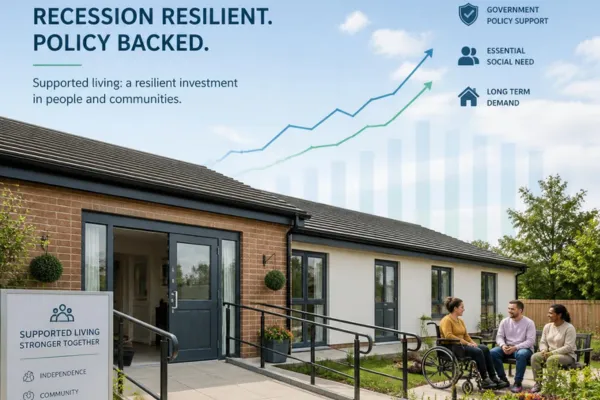
Why Supported Living Remains Recession-Resilient: CPI+1%, Occupancy & Policy Backing
Supported living and specialist housing continue to attract attention from investors and providers seeking stable, socially impactful opportunities in the UK property market. Amid economic uncertainty, this sector demonstrates defensive qualities rooted in structural demand, policy support, and inflation-linked income streams. Recent regulatory developments reinforce this resilience while highlighting the need for careful structuring and due diligence.
The UK supported living sector provides housing with care and support for vulnerable groups, including older people, individuals with learning disabilities, mental health needs, and those experiencing homelessness or domestic abuse. Unlike general private rented sector (PRS) housing, which can fluctuate with discretionary spending and economic cycles, supported living addresses essential, needs-based requirements. Chronic undersupply and government policy frameworks position it as a relatively defensive asset class.
Key recent developments include the Rent Standard 2026 and the establishment of the National Housing Bank, which together provide longer-term certainty for rents and funding in social and specialist housing.
Several interlocking factors support the sector’s recession resilience.
CPI+1% Rents and Policy Certainty
From April 2026, the Regulator of Social Housing’s Rent Standard 2026 allows social landlords to increase rents for social rent and affordable rent homes (including supported housing) by up to CPI + 1% per year as part of a 10-year settlement running to March 2036. Supported housing often benefits from additional flexibility, such as rents up to 10% above formula rent.
This formula links income growth to inflation plus a modest real uplift, helping maintain real returns even when broader economic conditions are challenging. The long-term settlement enables better planning for maintenance, compliance, and new supply. The National Housing Bank further strengthens the picture by deploying significant public investment capacity to unlock additional private funding and support social and affordable housing delivery, including specialist schemes.
High Occupancy Driven by Structural Demand
National Housing Federation analysis estimates a current shortfall in supported housing units, with a base case need for around 167,000 additional units by 2040 simply to keep pace with demographic change. In higher-need scenarios, the figure could reach support for up to 1.7 million people. Demand is driven by an ageing population and ongoing requirements among working-age adults.
This persistent undersupply, combined with referral pathways from local authorities and the NHS, supports strong occupancy levels in well-managed schemes. Unlike market-rate housing, tenant demand here stems from assessed needs rather than economic confidence, providing greater stability through downturns.
Social Impact as a Resilience Factor
Beyond financial metrics, supported living delivers measurable public value by enabling independent living, reducing pressure on hospitals, residential care, and homelessness services. This alignment with government priorities in housing, health, and social care adds another layer of policy resilience.
Yields in Small En-Suite Schemes
Small 5- to 6-bed en-suite schemes (often structured as compliant HMOs or self-contained units) can offer attractive potential yields in suitable locations when acquired at appropriate prices and paired with strong operators. Sector commentary frequently references net yields in the region of 8-12% in structured deals with CPI-linked leases, though actual outcomes vary significantly based on purchase price relative to underlying value, management costs, and void performance. These compare favourably to many traditional buy-to-let opportunities but require rigorous assessment.
Practical Insights for Investors and Providers
Prioritise Quality Structures: Focus on schemes with strong registered providers, clear nomination agreements, or direct local authority ties. Independent RICS valuations (not solely income-dependent) and thorough operator due diligence (CQC ratings, financial stability) are essential.
Stress-Test Scenarios: Model performance under sustained inflation (beneficial via CPI+1%), operator disruption, or localised referral changes. Diversification across operators and geographies helps mitigate single-point risks.
Compliance and Risk Management: Pay close attention to regulatory requirements, including exempt accommodation rules where applicable. Over-reliance on “guaranteed” income from fragile operators or paying significant premiums above market value can undermine long-term returns and liquidity. Specialist assets can be harder to exit, so adopt a long-hold mindset. For a detailed perspective on common pitfalls, see this balanced analysis on risks in supported living investments.
Opportunities in Small Schemes: Conversions or purpose-adapted small en-suite properties in high-demand areas can align with local needs while offering hands-off potential when professionally managed, provided purchase economics stack up after full due diligence.
Timely Policy Link
The 10-year rent settlement and National Housing Bank initiatives, alongside exemptions under the Building Safety Levy for most supported housing developments, create a supportive environment for compliant supply. These measures align with broader government goals around housing delivery and social infrastructure, reducing certain cost pressures and signalling continued policy focus on the sector.
Supported living stands out for its combination of policy-backed, inflation-linked income, structurally high occupancy potential, and meaningful social contribution. While not without risks — particularly operator dependency and valuation discipline — the sector’s defensive characteristics make it a considered option for diversified, impact-oriented portfolios when approached with transparency and professional scrutiny.
👉 Want to understand how supported living’s recession-resilient features, including CPI+1% rents and policy developments, could fit within your portfolio strategy? Connect with Shannon Hoang at SHPC to explore how we help investors and providers navigate these opportunities with clarity and confidence.
⚠️ Disclaimer: This article is for general information only and should not be relied upon as legal, financial, or investment advice. Property investments carry risks, and details of policy and regulatory matters remain subject to ongoing interpretation and potential change. Please seek professional advice tailored to your circumstances.
