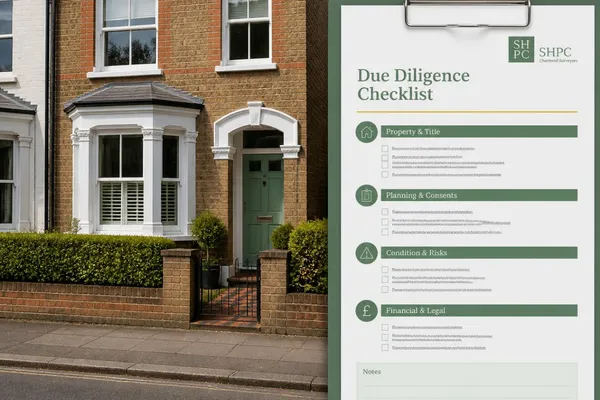
Due Diligence Checklist for 2026–27: What Every Property and Supported Housing Investor Must Stress-Test
The 2026–27 year is not a quiet one for UK property, and it is even less quiet for supported housing. Several reforms that have been discussed for years are now landing on fixed dates. Section 21 no-fault evictions end for the private rented sector from 1 May 2026, as set out in the government’s Renters’ Rights Act 2025 implementation roadmap. Social landlords face a wider set of Awaab’s Law repair deadlines from 30 November 2026. The Building Safety Levy applies to relevant building-control applications from 1 October 2026. Local authorities in England must publish Supported Housing Strategies by 31 March 2027 under MHCLG statutory guidance. A locally led licensing regime for supported exempt accommodation is expected from 2027, following the government’s April 2026 consultation response on the Supported Housing (Regulatory Oversight) Act 2023.
For investors, that combination changes what “due diligence” means. Checking title, a survey and a yield sheet is no longer enough. The questions that now decide whether a scheme is resilient are legal status, Housing Benefit continuity, operator fitness, building safety evidence, and whether the host council actually needs the product you are buying.
This article sets out the checks that matter in 2026–27, with the risks and the genuine opportunities held in view. It is written for England, because the 2023 Act, the Rent Standard 2026 and the Levy framework described here are England-focused. Wales, Scotland and Northern Ireland follow different tracks.
Why 2026–27 is a stress-test year
Supported housing has always sat across several systems at once: housing law, Housing Benefit, planning, building safety, and sometimes Care Quality Commission registration. The stress in 2026–27 is that those systems are tightening at the same time, while public policy is also trying to grow supply.
On the supply side, the ten-year Social and Affordable Homes Programme is now allocating capital and has asked providers to bring forward ambitious supported and specialist housing bids. Homes England’s National Housing Bank is offering low-cost loans to registered providers. A ten-year social rent settlement at CPI+1% from April 2026, set out in the Direction on the Rent Standard 2026 and confirmed by the Regulator of Social Housing, gives registered-provider counterparties more rent certainty than they have had in recent years. Supported housing also keeps a higher rent-flexibility allowance under the Rent Standard 2026 (10% above formula rent, against 5% for general needs), and specialised supported housing remains outside that Standard. Bedroom rent caps for 2026–27 are published in RSH’s limit on annual rent increases 2026–27.
On the risk side, quality and licensing are catching up. The government’s April 2026 response on the 2023 Act confirmed a locally led licensing regime for supported exempt accommodation, National Supported Housing Standards, and a link between Enhanced Housing Benefit and holding a licence. Homeless Link’s briefing on the response and its implementation overview are useful sector reads of the same material. An expanded list of already-regulated services will be exempt. Proposals for a statutory minimum threshold of care, support and supervision in Housing Benefit rules were paused. That pause is important. It reduces one immediate cliff-edge, but it does not remove the direction of travel: public money is being tied more tightly to licensed, evidencable support.
The House of Commons Library briefing on supported exempt accommodation and the National Housing Federation’s Act page are also worth keeping open while regulations are still being drafted.
The practical implication is simple. A scheme that looks attractive on paper can still fail if the operator cannot obtain a 2027 licence, if Housing Benefit evidence is weak, if the occupation agreement is an assured shorthold tenancy caught by the Renters’ Rights Act, or if the building cannot meet fire, electrical, damp and energy duties without a capital programme that destroys the yield.
The checklist investors should run
1. Identify the legal animal, not the marketing label
“Supported living” is a brochure phrase. Due diligence needs the legal category in the 2023 Act and in Housing Benefit rules.
Ask:
Is this supported exempt accommodation, specialised supported housing, a care home, temporary accommodation, or a standard HMO let to a vulnerable cohort?
Who is the landlord: a registered provider, a charity, a CIC, a private company, or a lease-based structure sitting under an RP?
What is the occupier’s agreement: social rent tenancy, licence, or a private assured tenancy?
Is personal care being provided, which may bring CQC registration, or only housing-related support?
Those answers decide which rent rules apply, whether Section 21 still exists as an exit route (for most private tenancies, from 1 May 2026, it does not), whether Awaab’s Law timeframes apply, and whether a 2027 supported-housing licence will be required.
Mixing categories is a common source of bad underwriting. Specialised supported housing, exempt accommodation and ordinary supported social rent are not interchangeable.
2. Stress-test Housing Benefit and rent, not just headline yield
Cashflow in this sector is a policy instrument. Check:
Whether rent sits inside the Rent Standard 2026, outside it, or in the exempt or specified accommodation world.
How service charges are evidenced. Incomplete support records and service-charge files are already producing queries and underpayments.
What happens to Enhanced Housing Benefit if the scheme is unlicensed after the new regime starts. The government response said Enhanced HB will be linked to a licence.
Whether the operator can show genuine care, support or supervision, even though a statutory minimum threshold has been paused.
CPI+1% from April 2026 for social rent, plus the extra flexibility for supported housing.
The Housing Benefit (Earned Income Disregards) (Amendment) Regulations 2026, in force from 5 October 2026, also change how earnings are treated for residents in specified or temporary accommodation. That is a resident-outcome reform, not a landlord windfall, but it belongs in any scheme-purpose note. Shelter’s Housing Benefit calculation rates 2026 to 2027 remain a practical rates reference.
Model voids on the assumption that possession is slower. The implementation roadmap and Homeless Link’s regulations timeline both flag specific supported-housing possession grounds. A specific ground is not the same as a quick exit.
3. Check the host council’s emerging Supported Housing Strategy
By 31 March 2027 every English local housing authority must publish a Local Supported Housing Strategy and needs assessment, then update it at least every five years. That duty sits in the 2023 Act and is explained in Local Supported Housing Strategies (published 10 February 2026).
Before exchange, ask:
Does this council already have a draft needs picture, and does it include your cohort (homelessness, learning disability, mental health, older people, domestic abuse, and so on)?
Is the scheme commissioned, or non-commissioned and relying on Housing Benefit alone?
Will the council treat the operator as a known, data-sharing partner before licensing begins?
The Local Government Association’s supported housing guidance for councils is a good window into how authorities are likely to inspect support and treat non-commissioned providers. A building in a borough that does not need that product, or that is preparing to thin out poor non-commissioned supply, is a different asset from a building aligned with an identified gap.
4. Run building safety, fire and Levy checks with evidence, not assumptions
For standing stock:
Height, storeys and number of residential units. Higher-risk building status under the Building Safety Act 2022 (generally 18 metres or seven storeys with at least two residential units) and “relevant building” status from 11 metres or five storeys change the legal duties.
Building Safety Regulator registration, building assessment certificate, Safety Case and Golden Thread where they apply.
Current fire risk assessment, outstanding actions, EWS1 or external-wall assessment, and who pays for any remediation. Live stock figures sit in MHCLG’s Building Safety Remediation monthly data.
Building Regulations completion or regularisation certificates for conversions. Missing sign-off is an enforcement and insurance problem, not a historic paperwork gap.
For new-build or conversion:
The Levy applies from 1 October 2026 to relevant applications for new dwellings and purpose-built student bedspaces. See the Levy guidance and The Building Safety Levy (England) Regulations 2025.
Social housing and supported housing can be exempt if they meet Schedule 2 definitions. The exemption is evidential. A private vehicle with thin support may not qualify simply because the brochure says “supported living”.
5. Price the 2026–27 quality duties into capex
Awaab’s Law Phase 1 already covers damp, mould and emergency hazards in social housing from 27 October 2025. Phase 2, from 30 November 2026, extends strict investigation and repair timescales to excess cold and heat, falls, structural collapse, fire and explosions, electrical hazards and hygiene, as set out in MHCLG’s Phase 2 announcement. Phase 3 follows in 2027 for remaining Housing Health and Safety Rating System hazards, other than overcrowding.
Also build in:
Five-yearly electrical inspection condition reports, phased through 2026 for existing social tenancies.
The Competence and Conduct Standard for registered providers from October 2026, summarised in the government’s decade of renewal update.
EPC rating and current Minimum Energy Efficiency Standards as they stand today, plus a sensible allowance for tighter future standards. Treat future thresholds as subject to further legislation rather than as already-commenced law.
The reformed Decent Homes Standard government response (January 2026). The new standard is set to apply from 2035 to social and private rented homes, including supported housing, with extra guidance still to come. 2035 is not tomorrow, but 2026–27 is when asset plans have to start.
A Level 3 RICS building survey, read against HHSRS hazards rather than against a lender’s minimum, is the right physical starting point for converted street properties.
6. Diligence the operator as hard as the bricks
Supported housing transactions fail more often on the operator than on the roof.
Check:
Companies House, Charity Commission and insolvency history.
Related-party leases and whether the rent in the investment model can survive a regulator or Housing Benefit challenge.
CQC rating if the service is a regulated activity.
Governance and viability grading if the landlord is a registered provider.
Staffing, on-call arrangements and whether the support model will meet National Supported Housing Standards once those are set in regulations.
Fit-and-proper-person risk under the forthcoming licence.
Insurance: buildings, employers’ and public liability, and professional indemnity matched to the support model.
Homeless Link reports that licences are expected to sit at local-authority level, with all authorised addresses listed, rather than one licence per scheme. That is better than a scheme-by-scheme licence, but it also means one failed fit-and-proper assessment can sit across a whole local portfolio.
7. Do not skip ordinary property due diligence
Specialist branding does not replace:
HM Land Registry title, restrictions, charges and headlease covenants (use, alienation, alterations, insurance, forfeiture).
Planning use class via the local planning authority and Planning Portal, plus Article 4 directions and HMO licensing. A future supported-housing licence does not automatically replace an existing HMO or selective licence.
Environment Agency flood risk, contamination and climate exposure.
Seller enquiry replies, including Building Safety Act questions now standard in commercial packs.
Timely policy link
Three calendars should sit at the front of any 2026–27 investment paper:
1 May 2026: Renters’ Rights Act Phase 1 for the private rented sector. Section 21 ends. Periodic tenancies and controlled rent increases begin. Supported housing has specific possession grounds, but private investors using ASTs need to model that change now.
1 October 2026 and 30 November 2026: Building Safety Levy on relevant new applications, and Awaab’s Law Phase 2 for social housing hazards beyond damp and mould.
31 March 2027, then 2027 licensing: Local Supported Housing Strategies must be published. Licensing and the Enhanced Housing Benefit link are expected to follow once regulations are consulted on and laid, as restated in the consultation outcome. Until those regulations exist, treat licence conditions as a known direction with unfinished detail.
Alongside that tightening sits the Social and Affordable Homes Programme, the National Housing Bank, and the commitments in A National Plan to End Homelessness, including targeted supported-housing funding for 2026/27 to 2028/29. Public capital is available for the right supported and specialist product. That is an opportunity for well-evidenced schemes aligned with local need. It is also a competitive risk for purely private schemes that cannot show quality, support and strategic fit.
What good looks like in practice
A resilient 2026–27 file usually has five documents that many data rooms still lack:
A one-page legal-status note: tenure, landlord type, occupation agreement, CQC position, and whether licensing under the 2023 Act is expected to apply.
A Housing Benefit and support-evidence pack, not only a rent roll.
A building-safety and hazards tracker mapped to Awaab Phase 2 and fire duties.
Written evidence of Levy exemption or a costed Levy assumption for new work, using Schedule 2 of the 2025 Regulations.
A note on the host council’s strategy timetable under the February 2026 guidance and whether the operator is already sharing stock and needs data with that council.
If those five cannot be produced, the price should reflect uncertainty. If they can, the sector’s long-term demand story still stands. Supported housing remains a necessary part of homelessness, care and independent-living policy. The 2026–27 reforms are an attempt to keep that supply while removing poor provision. Investors who treat regulation as a filter, rather than as an afterthought, are the ones the next five years are being designed for.
Due diligence for 2026–27 is a test of classification, cashflow policy, building condition, operator quality and local need. The opportunity is real where a scheme is licensed-ready, aligned with a council’s emerging strategy, and capex-honest about fire, electrics, damp and energy. The risk is equally real where the investment case depends on an unexamined “exempt” label, an operator who cannot evidence support, or a private tenancy model that has not been rewritten for life after Section 21.
The unfinished piece is the licensing regulations themselves. Any decision taken before those regulations are published should include a clear watchpoint and a plan for what happens if licence conditions are tighter than expected.
👉 Want to understand how 2026–27 licensing, Housing Benefit rules and building-safety duties could affect a supported housing or wider property strategy? Connect with Shannon Hoang at SHPC to explore how we help investors and providers work through these changes with clarity and care:
⚠️ Disclaimer: This article is for general information only and should not be relied upon as legal, financial, or investment advice. Property investments carry risks, and supported housing regulation, Housing Benefit rules, energy efficiency requirements and building-safety duties remain subject to further regulations and change. Please seek professional advice tailored to your circumstances.
