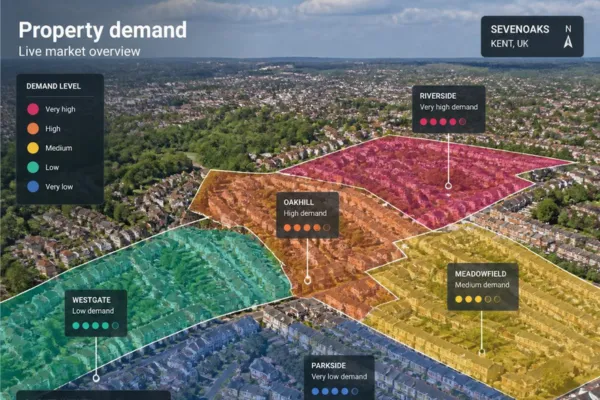
Where Is the Demand? The UK's Supported Living Supply Gap
For property investors, the question of where to invest often starts with familiar metrics: purchase price, rental yield, refurbishment costs and potential returns.
But when it comes to supported living, there is another question that arguably deserves to come first:
Where is there genuine unmet need?
The distinction matters. A low-cost property does not automatically represent a strong supported living opportunity. Equally, a location with high demand does not mean that every property in that area is suitable.
The more useful approach is to understand the relationship between local need, existing accommodation, future demand, local authority priorities and the type of property available.
This is becoming increasingly important as the UK faces a significant shortage of supported housing. The government's Supported Housing Review 2023 estimates that between 179,600 and 388,100 additional supported housing units are needed across Great Britain to address current levels of unmet demand. By 2040, the estimated requirement could rise to between 361,700 and 640,700 additional units, depending on how current unmet need and demographic trends develop.
The opportunity, therefore, is not simply about finding somewhere to buy cheaply. It is about understanding where the gap actually exists and whether a proposed property can help address it.
A national shortage does not mean every location has the same need
The Supported Housing Review 2023 found evidence of unmet demand across different client groups, with particularly significant pressures relating to people with mental health needs, single homelessness, people with learning disabilities and autistic people, and young people leaving care.
It also found that unmet demand can be particularly pronounced in areas with high market rents and in some rural locations.
The scale of the issue is significant.
Only 8% of commissioners surveyed indicated that, in their opinion, there was no unmet supported housing need in their local authority. Meanwhile, 86% expected demand to increase over the following five years, and 90% considered their local authority or County Council budget for commissioning supported housing insufficient to meet demand.
However, these figures should not be interpreted as meaning that investors can simply purchase property anywhere and expect demand to follow.
The same government research highlights an important problem: additional supply does not always meet local needs. Many local authorities reported difficulties understanding and overseeing non-commissioned supported housing, while some additional accommodation being created did not necessarily address the requirements of the local population.
That makes local research essential.
The shift from property price to local need
For a conventional buy-to-let investment, an investor may begin by comparing property prices and rents across different areas.
For supported living, the analysis needs to go further.
A property might look attractive because it is inexpensive, but questions remain:
Is there an identified need for this type of accommodation?
Which client group requires it?
Is there already significant supply nearby?
Does the local authority identify this type of provision as a priority?
Is the property physically appropriate?
Is there an experienced operator able to deliver the required support?
Is there a sustainable funding and commissioning structure behind the proposed model?
These questions can change the investment case considerably.
A low purchase price may be less meaningful if the property is difficult to operate, unsuitable for the intended residents or located in an area where the relevant accommodation is already well supplied.
Conversely, a property in a less obvious location may warrant closer consideration if there is clear evidence of unmet need and limited suitable supply.
Local authority strategies could become an increasingly important source of intelligence
This is particularly relevant now because the policy framework around supported housing is becoming more structured.
In February 2026, the government published its Local Supported Housing Strategies statutory guidance for councils in England.
The guidance establishes a framework requiring local authorities to understand their local supported housing landscape, including existing supply, unmet need and future demand, and to develop strategies based on local priorities.
The first Local Supported Housing Strategies are planned to be published by 31 March 2027.
For investors and providers, this could become a valuable source of local intelligence.
A local strategy should help answer questions such as:
What accommodation is currently available?
Where are the gaps?
Which groups are expected to require more support?
What are the council's strategic priorities?
How is future demand expected to change?
The government's guidance specifically states that local authorities should undertake a needs assessment covering supply and demand, determining the amount and types of supported housing required and using this assessment to inform strategic priorities and delivery plans.
This reinforces a simple principle:
Do not start with the property. Start with the need.
Demographics can help reveal where future pressure may develop
Current demand is only part of the picture.
Population structure is also changing, and those changes are not evenly distributed across the country.
The Office for National Statistics' subnational population projections provide population projections at local-authority level, allowing changes to be examined below the broad regional level.
This matters because supported accommodation requirements can be influenced by factors such as age, disability, health needs and household circumstances.
The wider social care picture also points towards increasing demographic pressure. Skills for Care's State of the Adult Social Care Sector and Workforce in England 2025 projects that if the adult social care workforce grows proportionally with the population aged 65 and over, approximately 470,000 additional posts could be required by 2040.
These figures do not, by themselves, prove that a particular location needs supported living accommodation.
They do, however, demonstrate why demographic analysis should form part of a wider location assessment.
An investor looking at a particular area might therefore examine:
population growth
growth in older age groups
disability data
local social care pressures
homelessness
care-leaver requirements
mental health needs
existing supported housing provision.
The important point is that demographics should be used alongside local supply and commissioning information, rather than in isolation.
Existing supply is just as important as demand
It is easy to focus on the size of the need and overlook the other side of the equation.
A location may have a substantial population requiring support, but if there is already significant suitable accommodation available, the investment case may be different.
This is why a proper location assessment should consider both sides.
Demand
Who needs accommodation, how much is required and how is that need expected to change?
Supply
What accommodation already exists, who provides it and does it actually meet the needs identified locally?
The gap
Where does suitable supply fall short of current or projected requirements?
This approach is consistent with the government's guidance on local authority interventions to improve quality in supported housing.
The guidance recommends that local authorities assess current need and existing supply, project future demand and supply, and identify gaps between them. It also highlights the value of understanding the number and type of existing schemes, the client groups they serve and areas where supported housing is concentrated.
For investors, this is an important distinction.
A headline national shortage should be treated as a reason to investigate, not as evidence that a particular property will automatically perform well.
The operator matters too
There is another consideration that can be overlooked when the discussion is focused primarily on property.
Supported living is not simply a property strategy. Accommodation sits alongside care, support or supervision designed to help people live as independently as possible.
That means the suitability of the property and the capability of the operator are closely connected.
A property may appear suitable on paper, but the practical model still needs to work. The operator needs to understand the needs of residents, staffing requirements, safeguarding, compliance and the relevant local commissioning environment.
There is also a wider workforce consideration. Skills for Care reports that the adult social care sector continues to face recruitment and retention challenges, while its latest projections indicate that around 470,000 additional posts could be needed by 2040 if workforce growth keeps pace with the population aged 65 and over.
This highlights another important lesson for investors:
Strong theoretical demand does not remove operational risk.
A location may have significant need, but the availability of an appropriate and sustainable support workforce is also relevant when assessing whether a model is viable.
Quality matters as much as quantity
There is another reason investors should look beyond simple supply figures.
Not every existing supported housing unit necessarily represents suitable supply.
The government's Local Authority Interventions to Improve Quality in Supported Housing guidance highlights concerns around poor-quality accommodation and support in parts of the sector.
The government has also continued to strengthen the regulatory framework. Its June 2026 response to the Supported Housing Regulation consultation states that the Supported Housing (Regulatory Oversight) Act 2023 is intended to help local authorities understand their local supported housing market and ensure that provision delivers what is needed, where it is needed.
For investors, this creates an important distinction:
The question is not simply how many units exist. It is whether suitable, good-quality provision exists for the people who need it.
That can make the assessment of existing supply more nuanced.
A more useful way to assess a potential location
Rather than asking simply, “Where can I buy property cheaply?”, investors could consider a five-part assessment.
1. What does the local authority say it needs?
Look at the council's housing strategy, supported housing strategy, commissioning information and other relevant local plans.
The new Local Supported Housing Strategy framework makes this particularly relevant for England.
2. Who needs the accommodation?
Understand the demographics and the specific client groups experiencing pressure.
Population projections, disability data and social care information can help provide context.
3. What already exists?
Map existing supported accommodation and consider whether there is sufficient suitable supply.
Where possible, understand:
the number of schemes
number of units
client groups served
commissioned and non-commissioned provision
concentration of provision
planned or proposed new schemes.
4. Where is the gap?
Look for evidence of unmet or growing need rather than relying on general assumptions about the area.
5. Does the property and operating model fit?
Only then should the physical property, refurbishment requirements, location, financing and potential returns be assessed.
This approach does not guarantee that an investment will succeed. It simply creates a more evidence-led starting point.
The opportunity is in the gap, not simply the discount
The UK's supported housing shortage is real, but it should not be reduced to a simple investment slogan.
Government evidence points to substantial unmet need, increasing future demand and significant barriers to creating new supply.
At the same time, local authorities are moving towards a more structured approach to assessing local supported housing needs and supply through Local Supported Housing Strategies.
For investors, that creates an opportunity to think differently.
The strongest question may not be:
“Where can I buy property cheaply?”
It may be:
“Where is there a clear gap between the accommodation people need and the suitable supply currently available?”
That shift changes the investment conversation from property price alone to need, suitability, supply, demographics and local strategy.
And ultimately, that is a more useful way to think about supported living investment.
A property should not simply be capable of producing a return. It should first make sense within the local housing and support ecosystem in which it will operate.
Looking ahead
The introduction of Local Supported Housing Strategies could provide investors and providers with a more consistent source of local information over the coming years.
With the first strategies planned for publication by 31 March 2027, understanding how councils assess their own supported housing needs may become increasingly important when evaluating new opportunities.
For investors considering supported living, the lesson is straightforward:
Research the need before researching the deal.
Price matters. Yield matters. Property condition matters.
But where there is genuine unmet need, suitable supply is limited, local priorities align and the operating model is credible, the underlying investment proposition may be worth investigating more closely than one based on price alone.
👉 Want to understand how local demand, supported housing priorities and regional differences could affect your property investment strategy? Connect with Shannon Hoang at SHPC to explore how we help investors and providers navigate the supported living market with clarity and confidence.
⚠️ Disclaimer: This article is for general information only and should not be relied upon as legal, financial, or investment advice. Property investments carry risks, and supported housing requirements, funding arrangements and regulatory requirements remain subject to change. Please seek professional advice tailored to your circumstances.
