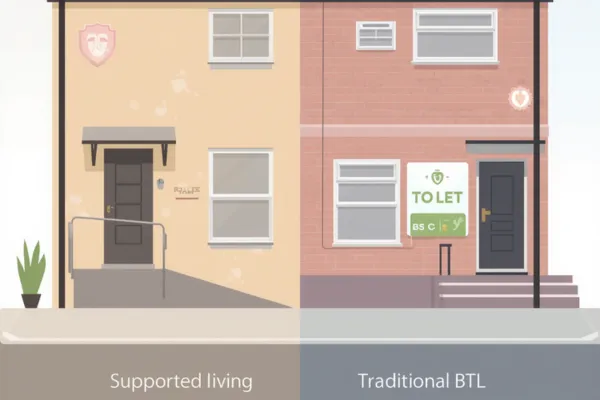
Supported Living vs Traditional BTL in 2026: A Side-by-Side Comparison
The UK private rented sector continues to evolve under significant regulatory changes in 2026. The Renters’ Rights Act has introduced major reforms for traditional buy-to-let (BTL) properties, while the Supported Housing (Regulatory Oversight) Act 2023 is advancing with new licensing preparations and local strategies. These developments create distinct operating environments for investors in supported living and standard BTL.
This article provides a balanced comparison to help property investors understand the key differences, opportunities, and considerations in the current landscape.
Core Models
Supported Living typically provides accommodation for vulnerable adults, such as those with disabilities, mental health needs, or learning difficulties. Housing is separated from care and support services, with tenants usually holding individual tenancies. Properties are often leased long-term to care providers or registered providers, who manage operations and ensure compliance.
Traditional Buy-to-Let (BTL) involves purchasing residential properties to rent to general market tenants under assured tenancies. Landlords or their agents handle tenant sourcing, management, maintenance, and compliance directly.
Key Differences in 2026
Supported living generally offers higher income predictability with lower void risk. Rents are often linked to housing benefit systems, and arrangements frequently involve longer-term commercial leases (for example, 20 to 25 years with CPI-linked increases). This model reduces day-to-day landlord involvement, as providers handle maintenance and tenant issues.
In contrast, traditional BTL relies on market-driven rents, which can bring greater potential for capital growth in strong locations but also higher exposure to voids, arrears, and tenant turnover. From May 2026, all new and existing tenancies convert to assured periodic tenancies with no fixed terms and no Section 21 no-fault evictions. Full details are available in the official Guide to the Renters’ Rights Act.
Regulation differs notably between the two. Supported living schemes fall under the ongoing implementation of the Supported Housing (Regulatory Oversight) Act 2023. This includes preparations for a licensing regime and national standards expected around mid-2027, alongside local supported housing strategies that local authorities must publish by March 2027, as outlined in the statutory guidance on Local Supported Housing Strategies.
Traditional BTL is directly affected by the Renters’ Rights Act, which strengthens tenant protections, introduces reformed possession grounds, and requires landlords to provide a mandatory information sheet to tenants.
Both models must address energy efficiency standards. Traditional BTL properties currently require a minimum EPC E rating, with a pathway toward higher standards. Supported schemes often include accessibility adaptations and may qualify for specific exemptions or funding support in certain cases. See the government guidance on minimum energy efficiency standards for landlords.
Tax and finance rules share a similar base, including Making Tax Digital requirements and stamp duty surcharges on additional properties. However, supported living may involve specialist lending products and commercial lease structures that can influence treatment.
Analysis: Opportunities and Risks
Supported living can appeal to investors seeking stable, longer-term income streams with reduced management burden. Alignment with government-backed funding and demographic demand for specialist accommodation supports resilience, although initial costs for property adaptations and refurbishments tend to be higher.
Traditional BTL continues to offer flexibility and potential for capital appreciation, but the 2026 regulatory changes increase compliance demands and operational risks for landlords.
Common risks across both include interest rate movements and rising compliance costs. Supported living carries additional considerations around provider stability and the needs of vulnerable tenants. Traditional BTL faces greater challenges with rent repayment orders and possession processes.
Practical Insights for Investors and Providers
Investors should conduct thorough due diligence. For supported living, review lease terms, provider track records, and alignment with upcoming local authority strategies. For traditional BTL, evaluate location-specific rental demand and projected EPC upgrade costs.
Diversification across both models may help balance income stability with growth potential. Company ownership structures can offer tax efficiencies in appropriate circumstances. Engaging solicitors, tax advisers, and surveyors at an early stage is advisable, particularly for adaptations or specialist finance.
Timely Policy Link
The Renters’ Rights Act took effect from May 2026, removing no-fault evictions and requiring landlords to issue the official information sheet. Meanwhile, the Supported Housing (Regulatory Oversight) Act progresses toward licensing and standards in 2027. These reforms, combined with ongoing EPC ambitions, highlight the need for proactive planning in response to priorities around tenant security, housing quality, and energy efficiency.
Supported living and traditional BTL represent different approaches to UK residential property investment in 2026, each with distinct risk-reward profiles shaped by regulatory reforms. Understanding these differences enables investors to make informed decisions aligned with their goals, whether prioritising stability or market flexibility.
👉 Want to understand how regulatory changes in supported living and traditional BTL could affect your portfolio strategy in 2026? Connect with Shannon Hoang at SHPC to explore how we help investors and providers navigate these developments with clarity and confidence.
⚠️ Disclaimer: This article is for general information only and should not be relied upon as legal, financial, or investment advice. Property investments carry risks, and regulatory requirements remain subject to consultation and change. Please seek professional advice tailored to your circumstances.
