Birmingham vs Manchester: Which Offers Better Returns for Property Investors?
For property investors looking beyond London, Birmingham and Manchester continue to attract attention as two of the UK's major regional investment markets.
Both cities have large economies, established rental markets and significant regeneration programmes. But which one offers better returns?
The answer depends on what an investor is looking for.
Rather than focusing on one headline figure, investors should consider purchase price, rental income, financing costs, demand, regeneration and potential long-term growth.
Birmingham: Lower Entry Point and Major Regeneration
Birmingham can offer investors a relatively lower entry point compared with Manchester.
The latest UK House Price Index for May 2026 recorded an average property price of £232,657 in Birmingham, compared with £247,469 in Manchester. Birmingham's annual price change was -0.3%, while Manchester recorded growth of 0.5%. These figures are local-authority averages and should not be treated as valuations for individual properties.
Birmingham is also undergoing substantial regeneration.
In May 2026, Birmingham City Council announced the launch of the Birmingham East Mayoral Development Corporation, supporting an £11 billion regeneration programme for East Birmingham. The programme is intended to support more than 50,000 jobs and 20,000 new homes while encouraging further public and private investment.
For investors, regeneration can be an important factor when assessing an area's future prospects, although planned investment does not guarantee property price growth.
Manchester: Strong Development and Housing Demand
Manchester has also continued to attract substantial investment and development.
Manchester City Council reported that 4,766 homes were completed in 2025/26, exceeding the number completed across all 32 Greater London boroughs during the same period. The city also completed 901 affordable homes.
The city is also progressing several regeneration programmes.
For example, the Water Street regeneration plans envisage a new city-centre neighbourhood with hundreds of new homes, a new urban park and additional commercial and leisure uses.
Manchester's Victoria North regeneration programme is another major development, with plans for more than 15,000 new homes across seven neighbourhoods over the coming years.
What About Rental Yield?
Headline rental yield can vary considerably depending on the property type and neighbourhood.
One current comparison using HM Land Registry and VOA data puts average gross rental yield at approximately 4.56% in Birmingham and 4.52% in Manchester. The same dataset shows a lower median property price in Birmingham but higher average monthly rent in Manchester. These are broad city-level indicators, not guaranteed returns on individual investments.
This highlights an important point: a higher rent does not automatically mean a better investment.
An investor should consider the relationship between purchase price and achievable rent, alongside mortgage costs, maintenance, management, insurance, void periods, taxation and compliance costs.
Birmingham vs Manchester: At a Glance
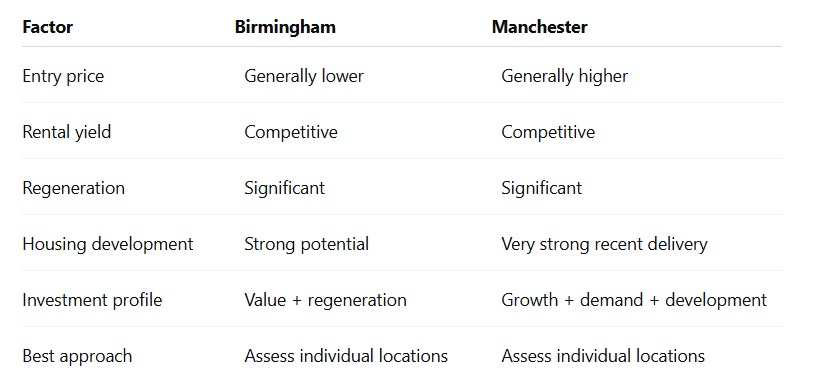
The latest data suggests neither city can simply be labelled the "winner."
Instead, the better question is:
Which city offers the right combination of price, rental demand, investment strategy and long-term fundamentals for your objectives?
What Should Investors Look At?
Before choosing between Birmingham and Manchester, investors should assess:
1. Purchase price
Does the property's price leave enough room for the required return?
2. Rental demand
Who are the likely tenants, and how consistent is demand for the property type?
3. Gross and net yield
Gross yield is only a starting point. Operating costs can materially change the actual return.
4. Regeneration and infrastructure
Planned transport, employment, housing and regeneration projects can influence an area's long-term prospects.
5. Financing costs
Mortgage rates and lending criteria can have a significant impact on cash flow.
6. Local supply and competition
A strong city-wide market does not mean every neighbourhood or property type will perform equally.
7. Exit strategy
Investors should consider not only rental income but also the potential resale market and future buyer demand.
So, Which Offers Better Returns?
There is no universal answer.
Birmingham may appeal to investors prioritising a lower entry point and exposure to major regeneration, while Manchester may appeal to investors attracted by strong development activity, established demand and a dynamic city economy.
However, the best investment opportunity may ultimately come down to the specific property and location, rather than the city name alone.
A property producing a strong headline yield can still deliver disappointing returns if financing, maintenance, voids or management costs are overlooked.
Key Takeaway
Birmingham and Manchester both offer compelling reasons for investors to pay attention.
The strongest investment decision is not necessarily about choosing the city with the highest headline yield. It is about identifying a property where the purchase price, rental demand, costs, location and long-term strategy work together.
Investors should carry out their own due diligence and seek appropriate independent professional advice before making an investment decision.
Ready to Explore UK Property Opportunities?
At SH Property Consultancy, we help investors assess UK property opportunities with a focus on location, investment fundamentals and individual objectives.
🌐 www.shpropertyconsultancy.co.uk
📞 079 4348 5748
Reference Links
Birmingham vs Manchester Rental Yield Comparison – July 2026
⚠️ Disclaimer: This article is for general information only and should not be relied upon as legal, financial, or investment advice. Property investments carry risks, and benefit rules remain subject to change. Please seek professional advice tailored to your circumstances.
